Case Law
The Shift in Apportionment: Analyzing the Recent En Banc Decisions
The landscape of apportionment in California workers' compensation law is undergoing a subtle but significant transformation.

Chris Lyle
Co-Founder & CEO
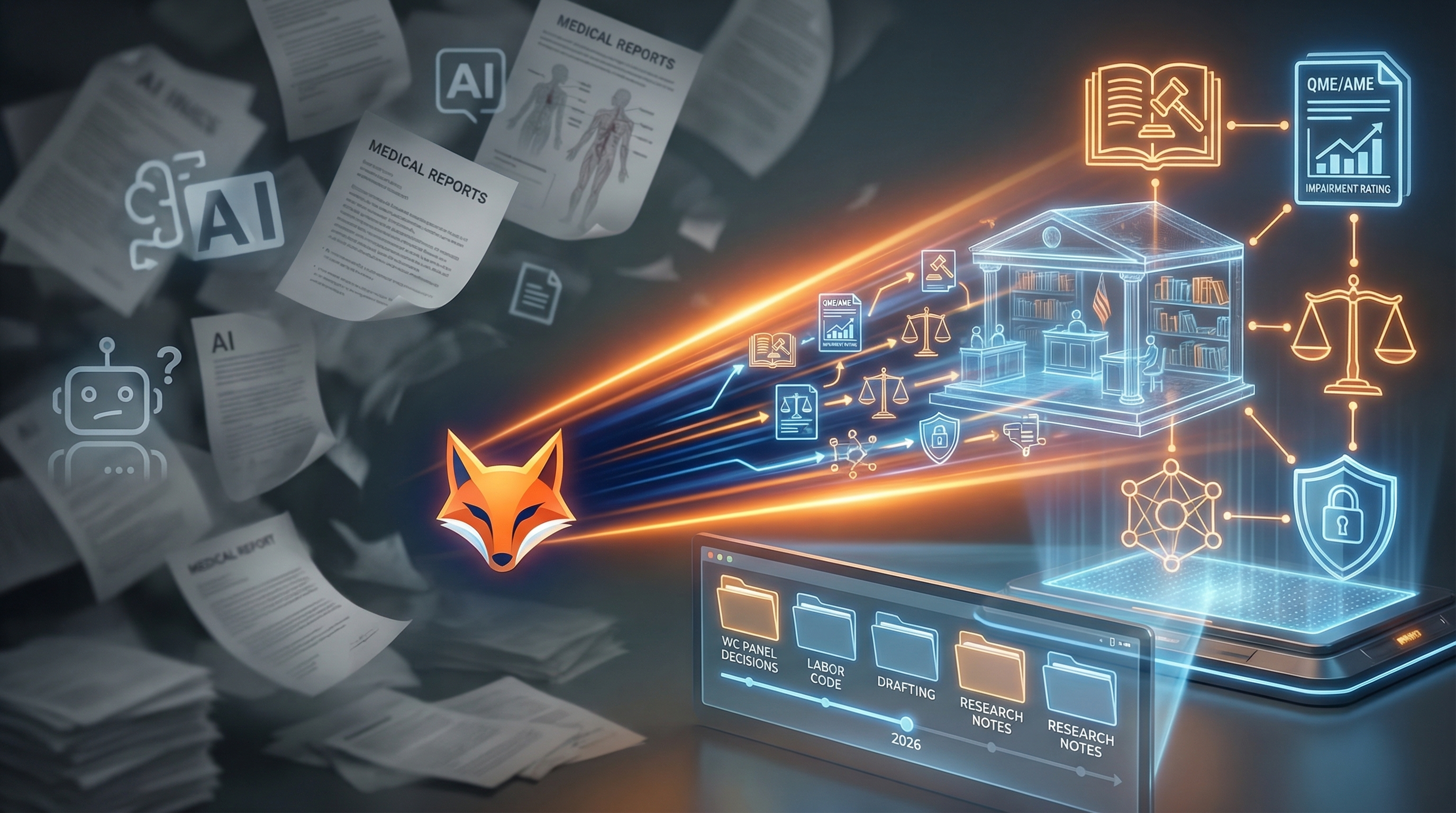
Generic AI tools are leaving workers' comp attorneys buried in QME reports, missing critical case citations, and losing ground to faster, better-equipped opponents — and the gap is widening in 2026. If you're still relying on ChatGPT to parse apportionment precedents or running WCAB decisions through a broad legal research platform designed for federal civil litigation, you're not just inefficient — you're outgunned.
Workers' compensation is one of the most document-intensive, citation-critical, and regulation-dense practice areas in law. Between navigating Labor Code sections, parsing AME and QME findings, tracking En Banc decisions, and drafting high-stakes documents like C&R agreements and trial briefs, the average WC attorney burns hours every day on work that a purpose-built AI can compress into seconds. General-purpose tools like ChatGPT or even broad platforms like Westlaw were not trained on the granular, jurisdiction-specific case law that determines outcomes in workers' comp. The practitioners winning in 2026 are the ones who have upgraded their research stack to match the complexity of their practice.
This guide breaks down what makes an AI legal research tool genuinely powerful for workers' compensation attorneys — and why vertical, WC-specific AI platforms are outperforming generic tools at every stage of the case lifecycle.
The problem isn't that general-purpose AI is bad — it's that workers' comp is too specialized for tools built to serve everyone. Generic platforms like ChatGPT, and even broad legal research databases with AI layers bolted on, lack training on WC-specific case law, Labor Code sections, and WCAB decisions [1]. When a defense attorney needs apportionment analysis under Labor Code Section 4664, or an applicant attorney needs to surface En Banc holdings on permanent disability ratings for specific body parts, a tool trained on general legal text simply doesn't have the depth to perform reliably.
The downstream effects are severe. Claims adjusters and TPAs using off-the-shelf AI tools miss jurisdiction-specific nuances that drive reserve accuracy and settlement strategy. Defense firms relying on horizontal platforms surface personal injury or employment law results that contaminate WC research workflows. And both sides of the caption face the same foundational risk: hallucinated citations in a trial brief or MSC memo [2].
AI hallucination — when a model fabricates citations, misquotes holdings, or invents regulatory references that don't exist — is a risk in every practice area. But workers' comp is especially vulnerable. The body of WC law is dense, jurisdiction-specific, and frequently updated through regulatory action and En Banc decisions that don't always surface in general legal databases with the speed or granularity practitioners need [1].
What does a hallucinated citation cost in practice? In a trial brief, it's a credibility catastrophe. In an MSC memo, it's a missed opportunity to anchor your position in controlling authority. In a denial letter, it's potential exposure. Hallucination-resistant AI architecture — the kind built on retrieval-augmented generation (RAG) frameworks grounded in verified, citable source documents — differs fundamentally from standard large language models that generate plausible-sounding text without tethering outputs to real authority.
QME and AME report review is where the inadequacy of general-purpose AI becomes most operationally painful. A typical workers' comp case file may include multiple physician reports spanning hundreds of pages — and the value in those documents lies not in any single report, but in the cross-referencing: where does the AME's causation opinion conflict with the treating physician's prior records? Where does the QME's impairment rating deviate from WCAB precedent for that body part and occupation?
Generic AI tools have no understanding of AMA Guides terminology in the context of California WC impairment ratings. They can't flag inconsistencies between treating physician reports and QME conclusions. They don't know what a PQME is or why the distinction from a panel QME matters at the WCAB [3]. Document-aware AI trained specifically on WC medical-legal reports is a fundamentally different capability — one that general tools simply do not possess.
Not all "legal AI" is created equal. When you're evaluating tools for a workers' comp practice, the criteria that matter are specific: training data specificity (is the model trained on WCAB decisions, En Banc rulings, and California Labor Code — or on a broad legal corpus where WC is a footnote?), citation accuracy and verifiability, document ingestion capability for QME and AME reports, speed of research output, workflow integration, and enterprise-grade security for client data [4].
The practitioners who get this evaluation right pull ahead fast. Those who settle for the closest existing tool from a vendor they already know pay the price in research hours, missed citations, and cases they shouldn't lose.
Vertical AI platforms — trained on a single practice area's case law, regulations, and document types — outperform horizontal tools on precision and relevance every time the research gets specific [5]. Fewer irrelevant results means faster decisions and less attorney review time. A tool that understands the difference between an applicant, a defendant, a QME, a panel QME, and a PQME in context — not just as vocabulary terms, but as legally significant distinctions with procedural consequences — delivers research outputs that are immediately actionable.
The compounding advantage is real: a tool that gets workers' comp right at the research stage improves every downstream task. Better research leads to better drafts. Better drafts lead to stronger positions at MSC and trial. The fastest firm to surface the right En Banc decision or apportionment precedent wins — and vertical AI is what makes that speed possible.
When evaluating WC-specific AI tools, prioritize these capabilities:
If a tool can't do all five at a professional standard, it's not your primary research engine for workers' comp.
The market has sorted into three tiers: purpose-built WC platforms, adapted general legal tools, and general-purpose AI assistants. The gap between tier one and tiers two and three has widened significantly in 2026. Here's an honest assessment.
CompFox is the only AI legal research platform trained exclusively on WCAB decisions, En Banc rulings, California Labor Code, and workers' comp case law. That exclusivity is the product — not a feature. The platform's hallucination-resistant architecture grounds every answer in verifiable, citable sources, which means you can take a CompFox research output directly into a brief without the citation verification audit that generic tools require.
For QME and AME report analysis, CompFox delivers a capability that doesn't exist anywhere else at this price point: upload a 300-page QME report and receive a structured summary of key findings, impairment ratings, apportionment conclusions, and flagged inconsistencies in seconds. Defense attorneys build cross-examination outlines from AI-flagged inconsistencies in medical-legal reports. Applicant attorneys identify where QME findings undervalue impairment relative to WCAB precedent — before the hearing, not after.
The natural language research interface is built for how WC attorneys actually think and query. You're not writing Boolean search strings — you're asking the question you'd ask a brilliant associate who has read every WCAB decision ever published. The draft generation capability produces first drafts of C&R agreements, settlement letters, trial briefs, and MSC memos grounded in actual case facts and real WCAB citations — not generic legal boilerplate.
Built for solo practitioners through mid-size firms, CompFox delivers enterprise-grade WC intelligence without enterprise bloat or enterprise pricing. Start Researching and see what purpose-built actually means when applied to a practice as demanding as workers' comp.
Westlaw and Lexis remain authoritative for statutory research and have genuine depth on federal and general civil law. Their AI layers — Westlaw AI and Lexis+ AI respectively — are competent tools for broad legal research. But they are not WC-specialized, and the difference shows immediately when you query for jurisdiction-specific WCAB decisions or need apportionment analysis grounded in California WC precedent.
Casetext CoCounsel offers strong brief-drafting assistance and is a legitimate tool for general civil litigation. It is not a WC-specialized platform. All three are priced for large firm budgets — Westlaw and Lexis enterprise subscriptions can run $500–$1,500+ per attorney per month — without delivering the WC-specific intelligence that solo and small WC firms actually need [5]. Best used as supplemental tools alongside a WC-specific platform, not as primary WC research engines.
Clear-eyed about these: they have zero training on WC-specific case law. Treat every output as a starting point for a human-supervised drafting process, never as finished research [1]. The hallucination risk for specific citations, Labor Code references, and WCAB holdings is unacceptably high for professional use in any WC matter. Useful for drafting boilerplate language when reviewed by an experienced practitioner. Not appropriate as a primary research tool for any workers' comp practice, full stop.
AI does not replace WC attorneys. It compresses the time-intensive stages so attorneys can focus on strategy and advocacy — the work that actually requires a lawyer's judgment. The firms winning in 2026 are using AI at every stage: intake, research, document review, drafting, and settlement analysis [3].
At intake, AI-powered research instantly surfaces comparable WCAB decisions by injury type, body part, occupation, and claimed mechanism of injury. Controlling authority on threshold issues — AOE/COE, statute of limitations, compensability — is available before the first conference, not after three hours of manual Westlaw searching. Claims adjusters and TPAs set accurate reserves faster with AI-driven case law benchmarking against real WCAB outcomes rather than gut instinct and analogical reasoning from memory.
This is where purpose-built AI creates the most dramatic competitive separation. Upload a 300-page QME report and get a structured summary of key findings, impairment ratings, apportionment conclusions, and inconsistencies in seconds. Cross-reference medical findings across multiple QME, AME, and treating physician reports automatically — the kind of analysis that previously required a paralegal burning a full day.
Identify where an AME's causation opinion conflicts with prior treating records before opposing counsel does. Defense attorneys build targeted cross-examination outlines from AI-flagged inconsistencies. Applicant attorneys quickly identify where QME findings undervalue impairment relative to WCAB precedent and build demand letters accordingly. This is your new superpower — and it's available to solo practitioners competing against defense firms with full research departments [4].
The drafting burden in workers' comp is relentless: C&R agreements, settlement letters, trial briefs, MSC memos, denial letters, IMR objections. AI-assisted drafting that references actual WCAB decisions and Labor Code sections — not generic legal boilerplate — reduces time-per-document from hours to under 30 minutes for experienced practitioners. Consistent document quality across the entire firm, regardless of associate experience level, is a side benefit that compounds in value as the firm scales.
Defense attorneys and applicant attorneys use AI differently — both win when the tool is WC-specific [2].
For defense practitioners, the highest-value AI research tasks are apportionment precedents under Labor Code Sections 4664 and 4663, QME credibility challenges, and settlement benchmarking. Research WCAB decisions where QME opinions were rejected on credibility grounds — build your attack before the hearing, not during. Benchmark proposed settlements against comparable WCAB outcomes to validate reserve positions and justify cost containment strategies to self-insured clients. Draft denial letters and IMR objections grounded in controlling authority, not generic template language.
Applicant-side practitioners get equal and opposite superpowers. Surface favorable WCAB and En Banc decisions on permanent disability ratings for specific body parts and occupations. Research penalty exposure under Labor Code Section 5814 and unreasonable delay findings efficiently — the kind of research that turns a settlement conversation when opposing counsel isn't prepared for it. Cross-reference treating physician findings against QME conclusions to identify undervalued impairment and draft demand letters with embedded case citations that reinforce maximum value arguments.
Attorneys using purpose-built AI legal research tools report saving 5–15 hours per week on research and document review [3]. At even a conservative $250 billable rate, 5 saved hours per week is $65,000 in recovered capacity annually — per attorney. Against an annual platform cost that is a fraction of a Westlaw subscription, the ROI math isn't close.
Westlaw and Lexis enterprise subscriptions run $500–$1,500+ per attorney per month — without WC specialization [5]. Purpose-built WC platforms deliver WC-specific intelligence at a fraction of that cost. The ROI calculation is straightforward: time saved per week × billable rate × 52 weeks vs. annual platform cost. For high-volume WC practices, the ROI breakeven on a purpose-built tool is typically under 30 days. Solo and small firm practitioners reclaim the competitive parity previously held only by large firms with deep research budgets — which is exactly the kind of competitive leveling that changes market dynamics in a practice area.
Start with a free trial focused on your highest-volume research tasks — apportionment, compensability, or permanent disability. Test citation accuracy immediately: query a known En Banc decision and verify the tool retrieves it accurately and completely. Evaluate document ingestion with an actual QME or AME report from a closed file. Assess workflow integration — does it reduce friction or add steps? Get buy-in from associates and paralegals; the tools that get adopted are the ones that actually save time for the whole team. And before ingesting any case files, confirm HIPAA-compliant data handling and client confidentiality protections.
Watch for these deal-breakers during evaluation:
If you're ready to run a real evaluation, Try Free Trial with a live QME report and an apportionment research query — and see whether the tool can do what it claims in your actual practice context.
Workers' compensation law is too specialized, too document-intensive, and too citation-dependent for generic AI tools to compete with purpose-built platforms. The best AI legal research tool for workers' comp attorneys in 2026 is one trained exclusively on WC case law and Labor Code, capable of analyzing QME and AME reports at scale, and built to generate accurate, citable research outputs in seconds — not hours. Whether you're defense-side maximizing apportionment under Labor Code Section 4664, applicant-side pushing permanent disability values with En Banc support, or a claims adjuster benchmarking reserves against real WCAB outcomes, the competitive advantage belongs to the practitioners using the right vertical AI stack.
Stop leaving research hours and case outcomes on the table with tools that weren't built for workers' comp. The practitioners who move first on purpose-built WC AI aren't just saving time — they're winning cases that their opponents, still running generic tools, are losing. That gap compounds every week. The question isn't whether to upgrade your research stack — it's how long you can afford to wait.
Workers' compensation is one of the most specialized and document-intensive areas of law, requiring deep familiarity with Labor Code sections, WCAB decisions, QME and AME reports, apportionment analysis, and En Banc holdings. Generic AI tools like ChatGPT and broad platforms such as Westlaw are not trained on this granular, jurisdiction-specific content. As a result, they frequently surface irrelevant results from personal injury or employment law, miss critical WC-specific precedents, and cannot reliably parse the nuanced regulatory landscape that drives outcomes in workers' comp cases. A purpose-built AI legal research tool for workers' comp attorneys is trained specifically on WC case law, Labor Code statutes, and WCAB decisions, allowing it to deliver accurate, relevant, and actionable research in a fraction of the time a generic tool requires.
AI hallucination occurs when a language model fabricates citations, misquotes legal holdings, or invents regulatory references that do not actually exist. In legal practice, this is a serious risk across all areas, but workers' compensation attorneys face heightened exposure because WC law is dense, jurisdiction-specific, and frequently updated through regulatory actions and En Banc decisions. A hallucinated citation in a trial brief can destroy credibility before a judge. In an MSC memo, it means failing to anchor your position in controlling authority. In a denial letter, it creates potential liability. To mitigate this risk, attorneys should look for AI platforms built on retrieval-augmented generation (RAG) frameworks, which ground all outputs in verified, citable source documents rather than generating plausible-sounding text from general training data.
While ChatGPT can assist with general writing and brainstorming tasks, it is not a reliable AI legal research tool for workers' comp attorneys handling complex issues like apportionment under Labor Code Section 4664 or permanent disability ratings for specific body parts. ChatGPT lacks training on the granular WCAB decisions and WC-specific case law that govern these outcomes. Relying on it for substantive legal research creates a real risk of hallucinated citations and inaccurate analysis, which can compromise briefs, memos, and settlement strategy. Attorneys serious about apportionment and PD analysis should use a vertical AI platform trained specifically on workers' compensation law and capable of retrieving verified, jurisdiction-specific authority.
QME and AME report review is one of the most time-consuming tasks in workers' comp practice. A single case file can include multiple physician reports spanning hundreds of pages, and the real analytical value lies in cross-referencing those reports — identifying where causation opinions conflict, where disability ratings diverge, and where treating physician findings contradict the QME's conclusions. A purpose-built AI legal research tool for workers' comp attorneys can compress this process dramatically by automatically identifying key findings, flagging inconsistencies across reports, and surfacing relevant case law tied to specific medical and legal issues within the reports. This allows attorneys to spend their time on strategy rather than manual document review.
When evaluating an AI legal research tool for workers' comp attorneys in 2026, look for several key factors. First, verify that the platform is trained specifically on workers' compensation law, including WCAB decisions, Labor Code sections, and En Banc holdings — not just general legal databases. Second, assess whether the tool uses a retrieval-augmented generation (RAG) framework to ground outputs in real, citable authority and reduce hallucination risk. Third, evaluate how the tool handles document-intensive tasks like QME and AME report analysis, C&R drafting, and trial brief preparation. Finally, consider whether the platform is updated regularly to reflect new regulatory developments and case law, since WC law evolves quickly and outdated training data can lead to unreliable research outcomes.
Yes, a specialized AI legal research tool for workers' comp attorneys benefits practitioners on both sides of the caption. Applicant attorneys can use these tools to surface favorable En Banc holdings on permanent disability ratings, identify controlling authority on causation and apportionment, and accelerate the review of medical-legal reports. Defense attorneys and their clients — including claims adjusters and TPAs — benefit from faster apportionment analysis, more precise reserve-setting based on jurisdiction-specific outcomes, and reduced risk of contamination from irrelevant personal injury or employment law results that appear in broader legal research platforms. The efficiency gains apply throughout the entire case lifecycle, from initial investigation through trial preparation and settlement negotiation.
In 2026, the gap between attorneys using specialized AI tools and those relying on generic platforms is widening rapidly. Workers' comp attorneys who adopt purpose-built AI research tools can complete citation research, document analysis, and brief drafting in a fraction of the time their competitors require. This creates a compounding advantage: more cases handled efficiently, lower research costs, faster turnaround on time-sensitive filings like MSC memos and trial briefs, and stronger legal arguments grounded in verified, jurisdiction-specific authority. Attorneys still using general-purpose tools or manual research methods are increasingly outgunned in terms of both speed and analytical depth, making the decision to upgrade to a specialized AI legal research tool a strategic necessity rather than a convenience.
[1] https://www.evenuplaw.com/guides/artificial-intelligence-in-legal-research. evenuplaw.com. https://www.evenuplaw.com/guides/artificial-intelligence-in-legal-research
[2] https://www.workerscompensation.com/additional-education-materials/ai-tools-revolutionizing-workers-compensation-claims/. workerscompensation.com. https://www.workerscompensation.com/additional-education-materials/ai-tools-revolutionizing-workers-compensation-claims/
[3] https://www.digitalowl.com/blog/best-ai-tools-for-your-lawsuit. digitalowl.com. https://www.digitalowl.com/blog/best-ai-tools-for-your-lawsuit
[4] https://sonix.ai/ai/ai-for-workers-compensation-lawyers/. sonix.ai. https://sonix.ai/ai/ai-for-workers-compensation-lawyers/
[5] https://szcomplaw.com/the-role-of-technology-and-ai-in-workers-compensation-defense/. szcomplaw.com. https://szcomplaw.com/the-role-of-technology-and-ai-in-workers-compensation-defense/
The landscape of apportionment in California workers' compensation law is undergoing a subtle but significant transformation.
Navigate California unemployment benefits with our complete 2026 guide. Learn eligibility requirements, weekly benefit amounts, claims process, and how the EDD determines your entitlements. Essential for claimants, employers, and legal professionals.
Apply these legal strategies instantly. CompFox helps you find decisions, analyze reports, and draft pleadings in minutes.