Case Law
The Shift in Apportionment: Analyzing the Recent En Banc Decisions
The landscape of apportionment in California workers' compensation law is undergoing a subtle but significant transformation.

Chris Lyle
Co-Founder & CEO
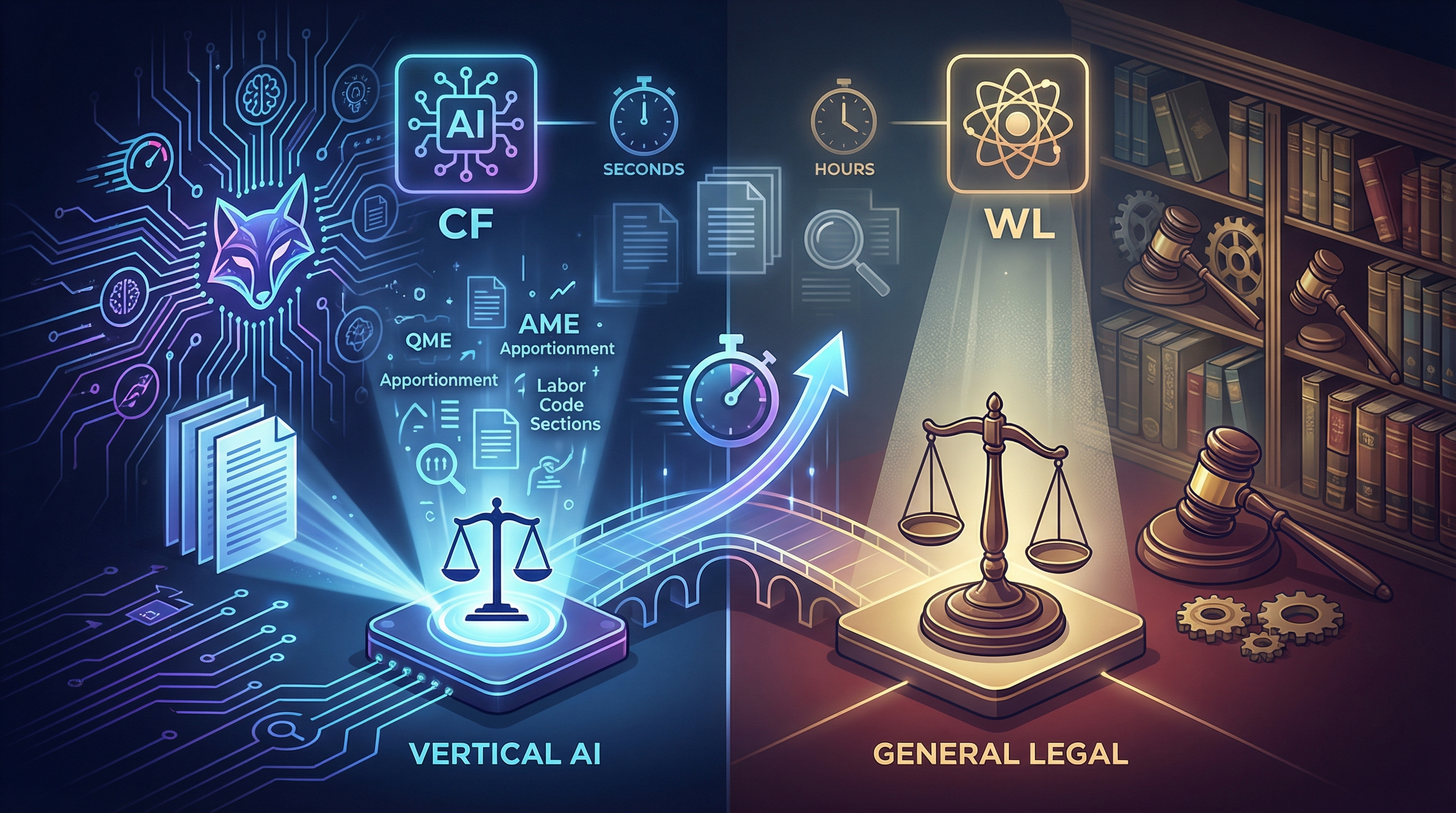
If you're still using Westlaw to research workers' compensation case law, you're bringing a Swiss Army knife to surgery — technically capable, but nowhere near purpose-built for the precision the job demands. Westlaw is an extraordinary legal research platform. It's also the wrong primary tool for a practice that lives and dies on WCAB panel decisions, apportionment arguments under Labor Code § 4663, and QME/AME report cross-referencing at scale.
Workers' compensation attorneys and claims professionals face a research environment unlike any other practice area. Between WCAB panel decisions, En Banc rulings, apportionment disputes, and the ever-shifting landscape of QME and AME report standards, the volume and specificity of WC case law is relentless. General-purpose legal research platforms like Westlaw were architected for broad legal coverage — not for the practitioner who needs to cross-reference causation findings across hundreds of panel decisions in under a minute.
This head-to-head breakdown of CompFox vs. Westlaw gives workers' comp practitioners a clear-eyed view of where each tool excels, where each falls short, and why the fastest firm in the room is increasingly the one that's gone vertical with AI purpose-built exclusively for workers' comp.
Westlaw is a horizontal platform — built to serve every practice area from tax law to constitutional litigation. Its workers' comp coverage is a slice of a much larger pie, and that architectural reality shapes everything downstream: how search results are ranked, what the AI is trained on, and how confidently it can surface the WCAB panel opinions that drive day-to-day WC strategy.
CompFox is a vertical AI platform engineered exclusively around the workers' compensation ecosystem: WCAB decisions, panel opinions, En Banc rulings, Labor Code sections, and regulatory updates. That's not a marketing distinction — it's an architectural one. The difference determines how the AI is trained, what it retrieves, and whether it can surface relevant precedent without hallucinating citations.
A purpose-built WC research tool is trained on workers' comp-specific corpora — not generic case law scraped from all jurisdictions and practice areas. CompFox's AI is trained to recognize WC-specific legal constructs: apportionment, permanent disability ratings, utilization review disputes, IMR decisions, and the Labor Code sections that govern them.
Westlaw's AI tools — including Westlaw Precision and its generative AI features — operate on a general legal knowledge base. That increases the risk of irrelevant results or missed niche WC precedent, particularly at the WCAB panel decision level where most practical strategy is built. For practitioners litigating before the WCAB daily, this distinction is the difference between a tool that speaks your language and one you have to translate for.
Westlaw's workers' comp coverage skews toward appellate decisions and statutory text — strong for foundational law, thinner on the WCAB panel decision volume practitioners rely on for day-to-day strategy. CompFox's case law database is built around the full universe of WCAB decisions, including panel opinions that rarely surface in generalist databases [1].
For defense attorneys managing high-volume files or applicant attorneys building apportionment arguments, panel decision depth is non-negotiable. Missing a controlling panel decision isn't a research inconvenience — it's a liability. When you query CompFox for decisions analogous to a specific fact pattern, you're pulling from a database purpose-indexed for exactly that kind of retrieval [2].
Westlaw is the gold standard for broad legal research — its statutory coverage, secondary sources, and citation network via KeyCite are genuinely best-in-class for general practice. For workers' comp practitioners, Westlaw's strengths show up in appellate research, Labor Code statutory analysis, and cross-jurisdictional comparisons.
The limitations emerge in high-frequency, high-volume WCAB research — the daily grind of finding analogous panel decisions on causation, psychiatric injuries, or apportionment under Escobedo. Westlaw's pricing model, designed for full-service law firms across multiple practice areas, often makes it cost-prohibitive for solo WC practitioners or boutique defense shops running lean dockets.
Pros: Unmatched breadth of legal sources, strong KeyCite citation validation, extensive secondary sources including treatises and practice guides, robust appellate and statutory coverage across all jurisdictions.
Cons: High subscription cost with tiered pricing that penalizes smaller firms, no WC-specific AI training, search results require significant filtering to find relevant WCAB decisions, and generative AI features carry hallucination risk on niche WC topics where the training corpus is thin.
The honest bottom line for WC shops: Westlaw is a powerful general tool that works adequately for workers' comp. But adequate isn't a competitive advantage — not when you're running 200 open files and opposing counsel is working with purpose-built vertical AI.
Free options like Google Scholar and the DWC's own online resources exist but lack the research depth and AI capabilities serious practitioners need. The WCAB's public decision database is searchable but unindexed for efficient research — finding analogous decisions manually is a multi-hour process that eats into billable time with no recovery path.
The real cost of "free" tools is practitioner time: hours spent manually reviewing documents that a purpose-built AI compresses into seconds. CompFox offers a free trial entry point that gives WC practitioners access to vertical AI without Westlaw's enterprise pricing structure — which means you can try a free trial and run a real research task before committing to a subscription.
CompFox is architected around one question: how do workers' comp practitioners actually work, and how do we make every step faster and more accurate? The platform's AI surfaces WCAB decisions, panel opinions, and Labor Code precedent with a specificity that generic tools can't replicate — and does it without hallucinating citations.
Cross-referencing medical findings across QME/AME reports, identifying apportionment arguments supported by analogous decisions, and drafting research memos are compressed from hours to minutes. For defense attorneys managing 200+ open files or applicant attorneys prepping for trial, the speed asymmetry between CompFox and a general-purpose tool is a genuine competitive moat.
Generative AI hallucination — fabricating plausible-sounding but nonexistent case citations — is a documented risk with general-purpose legal AI tools [3]. In workers' comp, citing a nonexistent WCAB decision before a Workers' Compensation Judge isn't just embarrassing — it's a professional responsibility issue that can affect your standing before the WCAB.
CompFox's proprietary AI is trained specifically on verified WC case law, reducing hallucination risk by anchoring outputs to a curated, domain-specific corpus. Every citation CompFox surfaces is traceable to a real decision — the kind of reliability practitioners need when filing a petition for reconsideration or prepping a trial brief on IMR disputes [4].
One of the most time-intensive tasks in workers' comp practice is reviewing and cross-referencing QME and AME reports — often 200+ pages per file, with causation opinions buried in dense medical-legal prose. Westlaw has no native capability for document-level medical report analysis; it's a case law and statutory research tool, and that boundary is structural, not a feature gap they're about to close.
CompFox's document analysis features allow practitioners to upload medical-legal reports and instantly surface key findings, causation opinions, and apportionment conclusions. For claims adjusters and legal ops leads at TPAs managing high file volumes, this capability alone can compress days of work into hours [5].
Westlaw: Strong citation validation via KeyCite for appellate decisions; thinner verification for WCAB panel opinions that don't surface consistently in its primary database.
CompFox: Hallucination-resistant AI trained on verified WC case law; every citation is anchored to a real, retrievable WCAB decision with traceable sourcing.
Verdict for WC practitioners: CompFox's domain-specific training delivers higher citation reliability for the WCAB decisions that matter most in daily practice. For appellate-level citation validation, Westlaw's KeyCite remains strong.
Westlaw requires practitioner-constructed queries, significant result filtering, and manual synthesis — research that takes 2–4 hours on a complex apportionment issue under Escobedo/Brodie. CompFox's natural language queries return WC-specific results in seconds; the AI synthesizes findings across decisions rather than returning a raw list of citations to manually review.
The fastest firm wins. In a high-volume WC practice, research speed compounds across every file on the docket. A firm running 150 open files that saves 90 minutes per apportionment research task is recovering dozens of billable hours every month — hours that flow directly to profitability or capacity.
Westlaw's enterprise pricing is designed for full-service multi-practice firms. Per-search or subscription models scale unfavorably for boutique WC shops and solo practitioners who don't need broad multi-jurisdictional coverage — they need deep WCAB coverage, fast.
CompFox's pricing is architected for the WC market — from solo practitioners to mid-size defense firms — with a free trial entry point that Westlaw doesn't offer. For a solo applicant attorney or a regional defense firm running lean, the cost-per-research-hour math increasingly favors a purpose-built vertical tool.
Illustrative cost-benefit scenarios:
The LexisNexis vs. Westlaw debate is a horizontal platform comparison — both are general legal research tools competing on breadth, secondary sources, and pricing tiers. For workers' comp practitioners, framing the choice as LexisNexis vs. Westlaw misses the more important question: does your practice demand vertical depth that neither general platform is designed to deliver?
CompFox isn't competing to replace every feature of Westlaw or LexisNexis — it's competing to own the WC research workflow where those tools leave practitioners underserved. Many high-volume WC shops run CompFox as their primary research tool and maintain a Westlaw or Lexis subscription for appellate and cross-jurisdictional work — a stack that delivers both depth and breadth without overpaying for general coverage you rarely use.
A defense attorney needs analogous WCAB panel decisions supporting apportionment of permanent disability to a pre-existing degenerative lumbar condition. On Westlaw, a Boolean or natural language search returns a mix of appellate decisions and law review articles; the practitioner spends 90+ minutes filtering for relevant WCAB panel opinions and manually synthesizing the holdings.
On CompFox, a natural language query — apportionment to pre-existing lumbar degeneration, WCAB panel decisions — returns a curated set of directly analogous decisions with AI-synthesized summaries in under two minutes. The speed differential on a single research task, multiplied across a 200-file docket, represents dozens of billable hours recovered per month.
An applicant attorney needs case law supporting a psychiatric injury claim where the industrial causation threshold is disputed. Westlaw surfaces the statutory text and appellate decisions clearly, but panel-level decisions on psychiatric injury causation require significant additional filtering and manual review to identify current WCAB analytical trends.
CompFox surfaces directly analogous WCAB decisions on psychiatric injury industrial causation — including recent panel opinions that reflect where the WCAB is trending analytically right now, not just where it stood five years ago in settled appellate law. Staying current on WCAB analytical trends is where vertical AI delivers an edge that horizontal platforms structurally cannot match.
Both LexisNexis's Lexis+ AI and Westlaw Precision use generative AI built on general legal corpora — neither is trained specifically on workers' compensation case law. For WC practitioners, the more relevant question is whether either general platform's AI matches the specificity of a vertical tool trained exclusively on WCAB decisions and WC-specific legal constructs.
The honest answer: for WC-specific research, a purpose-built vertical AI outperforms general legal AI on the tasks that consume the majority of a WC practitioner's research time. For broad appellate coverage and secondary sources, the general platforms remain strong. The intelligent move is knowing which tool you're picking up and why.
Cost is the most cited factor — enterprise pricing from both platforms is designed for large multi-practice firms and doesn't scale efficiently for boutique WC shops running focused dockets [3]. Relevance noise is the second driver: general platforms return broad results that require significant practitioner time to filter down to WC-specific precedent.
The emergence of purpose-built vertical tools delivering higher specificity at lower cost is accelerating churn from general platforms among specialized practice areas. For WC practitioners specifically, the calculation is sharpening: pay more for a general tool that does workers' comp adequately, or invest in a vertical tool that does workers' comp exceptionally well.
Transitioning from a general platform to a vertical tool doesn't require a hard cutover. The most effective migration path is parallel usage: run CompFox as your primary WC research engine while maintaining Westlaw access for appellate and cross-jurisdictional tasks during a transition period of 30–60 days.
Learning curve: CompFox's natural language interface is designed for practitioners who already know workers' comp — the system speaks your language, which means the onboarding curve is measured in hours, not weeks. If you know how to describe an apportionment argument or an IMR dispute in plain English, you already know how to query CompFox effectively.
Replicating existing workflows: Most Westlaw workflows in WC practice map directly — keyword and Boolean searches translate to natural language queries; citation-chaining on WCAB decisions is handled natively by CompFox's database architecture. The one workflow where Westlaw retains an advantage during transition is broad appellate citation validation via KeyCite, which is why many practitioners maintain a reduced Westlaw subscription for that specific use case after fully migrating their primary WC research.
Data portability: Research history and saved searches in Westlaw don't port directly, but CompFox's search interface makes reconstructing your core research workflows fast — most practitioners report that rebuilding their standard query set takes less than a day.
If you're ready to see the difference firsthand, start researching on CompFox — the free trial gives you full access to run your actual workflow, not a curated demo.
Westlaw is a legitimate powerhouse for general legal research — and for workers' comp practitioners who need appellate coverage, cross-jurisdictional analysis, or secondary source depth, it earns its place in the stack. That's not a concession; it's an accurate tool assessment.
But for the daily research grind that defines workers' comp practice — WCAB panel decisions, apportionment arguments under Labor Code § 4663, QME report cross-referencing, IMR dispute research — a general platform asking you to adapt to its architecture is the wrong primary tool. CompFox is purpose-built for the way WC practitioners actually work: fast, specific, hallucination-resistant, and fluent in the terminology of the WCAB without requiring translation.
In a practice area where speed compounds across hundreds of open files, the firm running vertical AI isn't just more efficient — it's operating with a structural advantage that general-tool firms can't close with harder work alone. The research asymmetry is real, it's measurable in billable hours recovered per month, and it widens every time WCAB issues new panel decisions that a general platform indexes slowly while CompFox surfaces immediately.
Stop filtering through noise. Try CompFox free and run your next apportionment research task in under two minutes — then decide which tool belongs in your workflow.
LexisNexis and Westlaw are the two dominant general-purpose legal research platforms, and the honest answer is that neither is decisively better overall — they are comparably powerful horizontal tools. Westlaw is widely praised for its KeyCite citation verification, natural language search, and intuitive interface. LexisNexis counters with Shepard's Citations, strong secondary source coverage, and robust news and regulatory databases. For most practice areas, preference often comes down to law school training, firm contract pricing, and personal workflow habits. However, when it comes to workers' compensation research specifically, both platforms share the same core limitation: they were built for broad legal coverage across all practice areas, not for the granular WCAB panel decision research, apportionment analysis, and QME cross-referencing that WC practitioners need daily. That's precisely why purpose-built AI tools like CompFox are gaining ground in workers' comp practices — they fill the vertical gap that both LexisNexis and Westlaw leave open.
Pricing for both LexisNexis and Westlaw is largely negotiated on a firm-by-firm or organization basis, making direct comparisons difficult. Both platforms offer tiered subscription models based on the number of users, practice areas accessed, and data modules included. Historically, both have been considered premium-priced platforms, with annual costs ranging from several thousand dollars for small firms to six-figure contracts for large organizations. Some surveys suggest LexisNexis can be slightly more affordable at the entry level, while Westlaw's comprehensive packages often command a premium. Neither platform is inexpensive. For workers' compensation attorneys evaluating cost-effectiveness, it's worth noting that general platforms like Westlaw and LexisNexis charge for access to their entire legal ecosystem — much of which a WC specialist may never use. A focused tool like CompFox, purpose-built for workers' comp, can deliver more targeted value at a fraction of the cost by concentrating resources specifically on WCAB decisions, panel opinions, and WC-specific precedent.
Assuming this question refers to LexisNexis rather than the automobile brand, the comparison mirrors the broader LexisNexis vs. Westlaw debate — and the answer remains highly context-dependent. Neither platform is universally superior. Westlaw tends to rank highly for case law search relevance and its KeyCite tool, while LexisNexis is often favored for its Shepard's citator, regulatory content, and news research capabilities. For workers' compensation research specifically, however, the more important question isn't LexisNexis vs. Westlaw — it's whether either general-purpose platform can match a purpose-built WC AI tool like CompFox. Both LexisNexis and Westlaw treat workers' comp as one slice of a massive legal database, which means WCAB panel decisions and niche WC precedent can be harder to surface efficiently. Practitioners who litigate before the WCAB daily increasingly find that vertical AI tools built exclusively for workers' comp outperform both horizontal giants for their specific research needs.
Both LexisNexis and Westlaw have invested heavily in AI features as of 2026. Westlaw Precision integrates generative AI capabilities powered by its legal database, while LexisNexis offers Lexis+ AI with conversational research and drafting tools. Both AI systems are trained on broad legal corpora spanning all practice areas and jurisdictions. In head-to-head comparisons, reviewers often note that Westlaw AI edges out LexisNexis AI for case law retrieval accuracy and citation reliability, while Lexis+ AI is praised for its conversational interface and drafting assistance. However, for workers' compensation research, both AI systems share the same fundamental weakness: they are generalist AIs operating on generalist databases. Neither is optimized to surface WCAB panel decisions, interpret apportionment disputes under Labor Code § 4663, or cross-reference QME findings at the depth that WC practitioners require. CompFox's AI, trained exclusively on workers' comp-specific corpora, is designed to fill exactly this gap — making the CompFox vs. Westlaw comparison more relevant for WC specialists than any Lexis vs. Westlaw AI debate.
Westlaw, owned by Thomson Reuters, has historically been LexisNexis' primary competitor in the legal research market. The two have dominated the market for decades, collectively serving the vast majority of law firms, courts, and legal professionals in the United States. Bloomberg Law has emerged as a credible third competitor, particularly attractive to transactional attorneys and corporate legal departments. In recent years, AI-native legal research startups have begun challenging the incumbents in specialized verticals. For workers' compensation specifically, CompFox represents a new category of competitor — not a direct LexisNexis rival across all practice areas, but a purpose-built alternative that outperforms both LexisNexis and Westlaw for WC-specific research. As the legal AI landscape matures in 2026, vertical AI platforms are increasingly capturing market share from horizontal giants in specialized practice areas where depth of coverage matters more than breadth.
Westlaw is one of the most powerful legal research platforms available, with a well-earned reputation across practice areas. Its key strengths include: an extensive case law database covering all federal and state jurisdictions, the industry-respected KeyCite citation verification tool, strong natural language and Boolean search capabilities, an intuitive interface with significant workflow integrations, and a growing suite of AI-powered research and drafting features through Westlaw Precision. On the downside, Westlaw is expensive — often prohibitively so for small firms — and its pricing model can feel like paying for a vast library when you only regularly visit one section. For workers' compensation practitioners evaluating CompFox vs. Westlaw, the most significant limitation is architectural: Westlaw is a horizontal platform not optimized for WCAB panel decisions, apportionment analysis, or the niche WC precedent that drives daily litigation strategy. Its AI tools, while impressive in general legal contexts, are trained on broad corpora and can miss or misrank critical WC-specific case law. For WC-heavy practices, Westlaw works best as a supplemental resource rather than a primary research tool.
Several free or low-cost alternatives to Westlaw exist for general legal research. Google Scholar provides access to a substantial library of federal and state court opinions at no cost. CourtListener and its PACER integration offer free federal court documents. Casetext offered a free tier before its acquisition, and Fastcase (now integrated into vLex) has historically provided affordable access through bar association memberships. For workers' compensation research specifically, free general platforms are rarely sufficient for serious case strategy. WCAB decisions are inconsistently indexed across free tools, and panel opinions — the backbone of most WC litigation — are difficult to locate and cross-reference without a purpose-built platform. CompFox, while not free, offers a cost-effective alternative to Westlaw specifically for workers' comp practitioners, providing deeper WC-specific coverage at a lower price point than a full Westlaw subscription. Many WC firms are finding that replacing or supplementing Westlaw with a vertical WC AI tool delivers better research outcomes at a more defensible cost per matter.
Attorneys and legal professionals opt out of LexisNexis for several common reasons. Cost is the most frequently cited factor — LexisNexis subscriptions represent a significant ongoing expense, and firms regularly reassess whether the return on investment justifies the spend, particularly when Bloomberg Law and Westlaw offer comparable coverage. Some users report that LexisNexis' interface feels less intuitive than Westlaw's, and that search result relevance can lag behind competitors for certain practice areas. Privacy concerns around LexisNexis' broader data business — which extends well beyond legal research into risk and identity verification markets — have also led some practitioners to reconsider the relationship. For workers' compensation attorneys specifically, opting out of or downgrading LexisNexis often coincides with adopting vertical AI tools like CompFox that deliver superior WC-specific research at lower cost. When evaluating CompFox vs. Westlaw or LexisNexis, WC practitioners increasingly find that a purpose-built platform outperforms both horizontal giants for their day-to-day research needs, making the premium subscription harder to justify.
[1] https://www.compfox.io/caselaw?query=Case%20Number%20ANA%200374183. compfox.io. https://www.compfox.io/caselaw?query=Case%20Number%20ANA%200374183
[2] https://www.compfox.io/caselaw?query=Victor%20Redula. compfox.io. https://www.compfox.io/caselaw?query=Victor%20Redula
[3] https://nevinlawgroup.com/what-is-the-best-way-to-find-a-lawyer-quizlet.html. nevinlawgroup.com. https://nevinlawgroup.com/what-is-the-best-way-to-find-a-lawyer-quizlet.html
[4] https://www.compfox.io/caselaw?query=Compwest. compfox.io. https://www.compfox.io/caselaw?query=Compwest
[5] https://www.compfox.io/caselaw?query=West%20Coast%20Interpreters. compfox.io. https://www.compfox.io/caselaw?query=West%20Coast%20Interpreters
The landscape of apportionment in California workers' compensation law is undergoing a subtle but significant transformation.
Navigate California unemployment benefits with our complete 2026 guide. Learn eligibility requirements, weekly benefit amounts, claims process, and how the EDD determines your entitlements. Essential for claimants, employers, and legal professionals.
Apply these legal strategies instantly. CompFox helps you find decisions, analyze reports, and draft pleadings in minutes.